


Starting with £1,000 might not feel life-changing.
It probably isn’t enough to retire on, generate a meaningful income or create overnight financial freedom.
But that completely misses the point.
The first £1,000 is not about becoming rich. It is about building the system that could eventually make you wealthy.
If I lost my investment portfolio tomorrow and had to start again with £1,000, this is exactly how I would approach it.
Before Investing the £1,000
This newsletter assumes I had already completed the important steps that come before investing.
I would have:
- learned the basic principles of investing;
- paid off any expensive short-term debt;
- built an accessible emergency fund;
- accepted that I would not need this money for at least five years.
Investing should not be the first step in your financial journey.
There is little point investing £1,000 if an unexpected car repair forces you to sell everything next month. Markets do not care when you need your money, and they will not always be rising when an emergency appears.
An emergency fund gives your investments time to recover during difficult periods.
Once that foundation was in place, I would be ready to invest.
Step One: I’d Use a Stocks and Shares ISA
My first decision would be the account, not the investment.
For most UK investors building wealth over the long term, I would start with a Stocks and Shares ISA.
Money invested inside an ISA can grow without UK Capital Gains Tax or Dividend Tax. The current overall ISA allowance is £20,000 per tax year, although that allowance is shared across the different types of ISA you use.
The tax benefits might not feel particularly important when your portfolio is worth £1,000.
However, you are not building an account for the person you are today. You are building it for the person you could become after investing consistently for 10, 20 or 30 years.
It is much easier to start inside the appropriate account than to worry about reorganising a much larger portfolio later.
Step Two: I’d Choose a Simple Platform
The two platforms I would personally consider are Lightyear and Trading 212.
Both have helped make investing more accessible by removing many of the traditional account and dealing charges associated with older investment platforms.
For my new portfolio, I plan to use Lightyear.
Lightyear currently charges no account, custody or ETF execution fees for personal accounts. Its published foreign-exchange fee is 0.1% when currency conversion is required. The underlying fund manager’s fee still applies when you own an ETF.
Trading 212 is also a platform I already use and remains a reasonable option for someone who prefers its interface and wider feature set.
I do not believe everyone needs to use the same provider as me.
The main things I would check are:
- whether the platform offers a Stocks and Shares ISA;
- whether it has the investments I want;
- its account, dealing and foreign-exchange fees;
- how easy it is to automate regular investments;
- whether I find the platform straightforward enough to use consistently.
A low-cost platform matters, but endlessly comparing tiny differences can become another excuse not to begin.
Choose a reputable, regulated platform that suits your strategy, understand its charges and move on to the more important decision: what you are actually investing in.
Step Three: I’d Keep the Investment Incredibly Simple
With my first £1,000, I would not attempt to build a portfolio containing 20 individual companies.
I would not try to identify the next Nvidia.
I would not divide the money between whichever investments had performed best during the previous year.
I would start with a broad, low-cost global index fund or ETF.
A global fund can give you exposure to hundreds or even thousands of companies across different industries and countries through one investment.
That could include businesses such as Microsoft, Apple, Amazon, Taiwan Semiconductor, AstraZeneca and many more. The companies and their weightings will change over time as the index changes.
Rather than trying to predict which individual company will dominate the next decade, I would own a slice of the wider market.
Funds I would research could include those tracking:
- the FTSE All-World;
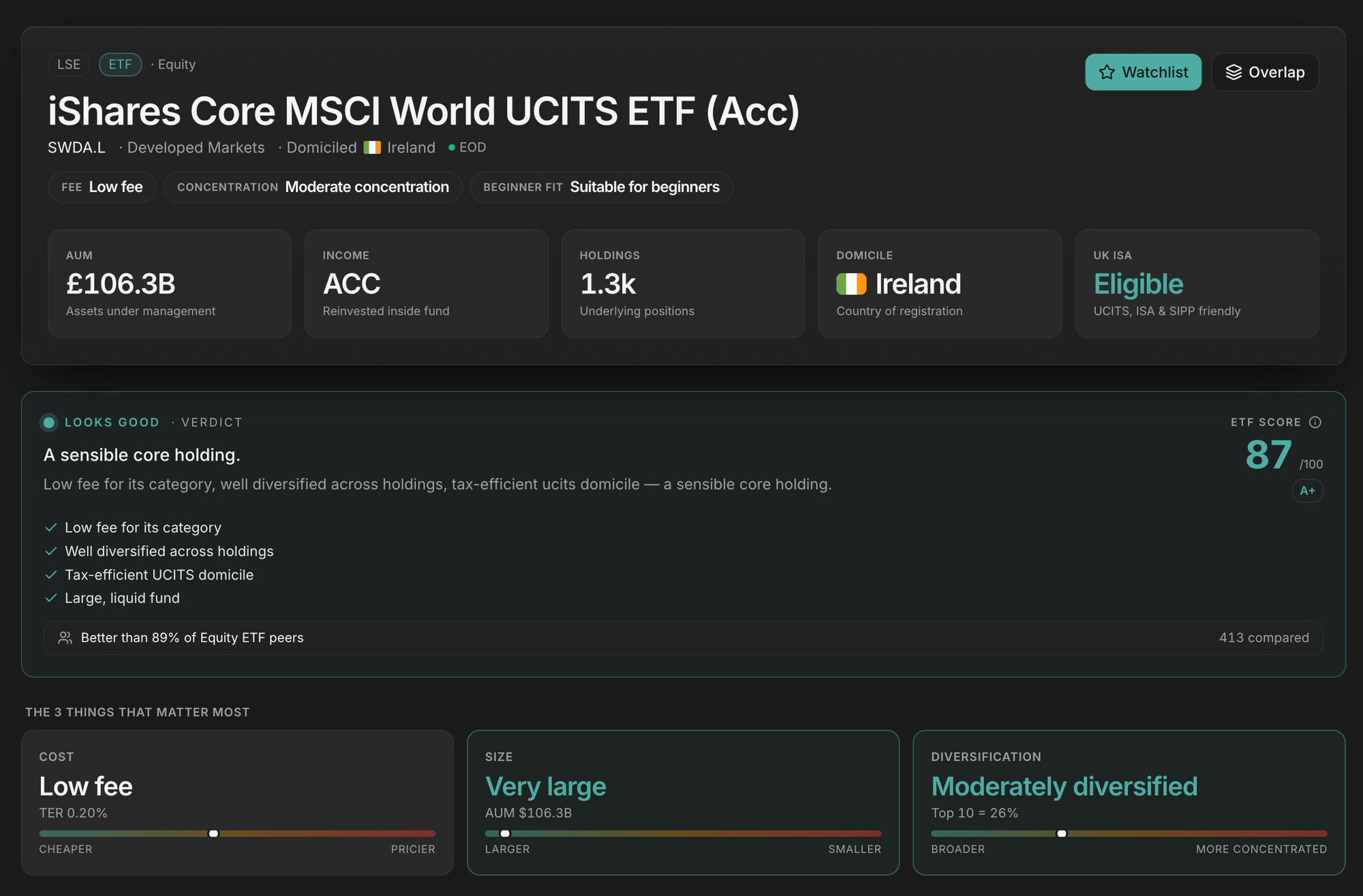
- the MSCI World;
- the MSCI ACWI;
- another broadly diversified global index.
These indexes are not identical. Some include emerging markets, while others only cover developed markets. Fund charges, size, structure and the treatment of dividends can also differ.
However, the broader principle is more important than selecting a supposedly perfect ticker.
I would use one diversified fund as the foundation and allow it time to work.
Your Money Mate ETF Screener
Find, Analyse and Research ETFs with our screener
What Have Global Markets Actually Returned?
Historical results can help demonstrate why long-term investing has been worthwhile, but they should never be treated as a promise.
As of 30 June 2026, the MSCI World Index contained 1,283 large and medium-sized companies from developed markets. Its published data also shows the scale of the risk involved: during the global financial crisis, the index experienced a maximum drawdown of approximately 58%.
That means an investor could have temporarily watched more than half of their portfolio value disappear.
This is why I would never invest money I expected to need shortly.
Over very long periods, diversified stock markets have historically produced positive returns despite crashes, recessions and political uncertainty. However, the return you receive depends heavily on your starting date, ending date, charges and the specific market you own.
For planning purposes, I might illustrate my future using a range of potential returns rather than assuming the most optimistic outcome.
Imagine I invested the initial £1,000 and then added £100 every month.
After 10 years, the illustrative results would be approximately:
| Assumed annual return | Total contributed | Illustrative value |
|---|---|---|
| 5% | £13,000 | £17,157 |
| 8% | £13,000 | £20,454 |
| 10% | £13,000 | £23,078 |
These figures are only mathematical illustrations. They do not account for platform fees, fund charges, taxes outside an ISA or the fact that real investment returns arrive unevenly.
The market will not politely deliver 8% every year.
One year could be strongly positive. Another could be negative. There may be extended periods in which your portfolio appears to make very little progress.
But the example demonstrates something important:
The initial £1,000 matters far less than what happens next.


