


If you are a UK investor looking for a simple way to invest globally, a global ETF is probably one of the first places you will end up.
Then you open Trading 212, Vanguard, InvestEngine, Lightyear or whatever platform you use, and suddenly it gets messy.
VWRP. VWRL. FWRG. IMID. All-World. ACWI. Developed markets. Emerging markets. Accumulation. Distribution.
It can get confusing very quickly.
So in this article, I want to keep it simple and compare three popular global ETFs for UK investors:
- Vanguard FTSE All-World UCITS ETF Accumulation, commonly known as VWRP
- Invesco FTSE All-World UCITS ETF, commonly known as FWRG
- SPDR MSCI All Country World Investable Market UCITS ETF, often known as IMID
This is not financial advice. It is just my opinion and a simple breakdown to help you understand what these funds actually do.
What is a global ETF?
A global ETF is basically a one-fund way to invest in companies around the world.
Instead of trying to pick individual stocks, or guessing which country will perform best, a global ETF gives you exposure to lots of different businesses, sectors and regions in one product.
That is the main appeal.
It is simple.
You are not trying to be clever. You are not trying to guess whether the UK, US, Europe, Japan or emerging markets will win over the next 10 years.
You are just buying a broad basket of global companies and letting the market do its thing.
For a lot of investors, especially beginners, that is a very sensible foundation.
Watch the full video
The biggest mistake investors make with global ETFs
One of the biggest mistakes I see is people buying too many global ETFs.
They will have VWRP, FWRG, an MSCI World fund, maybe an All-World fund, maybe another global ETF from a different provider.
The problem is that in many cases, they are buying the same thing over and over again.
Different name. Different provider. Similar holdings.
That creates unnecessary overlap.
If you already own a global ETF, you probably do not need three more global ETFs doing almost the same job. One strong global fund can act as the core of your portfolio. Then, if you want to add other areas around it, you can use satellite positions.
For example, you might add a UK dividend ETF, a smaller companies fund, a bond fund, a gold ETF, or a few individual stocks.
But the global ETF itself should usually be the main foundation, not something you keep duplicating.
All screenshots taken from our ETF & Stock Screener found in Plus Membership
1. Vanguard FTSE All-World UCITS ETF Accumulation, VWRP
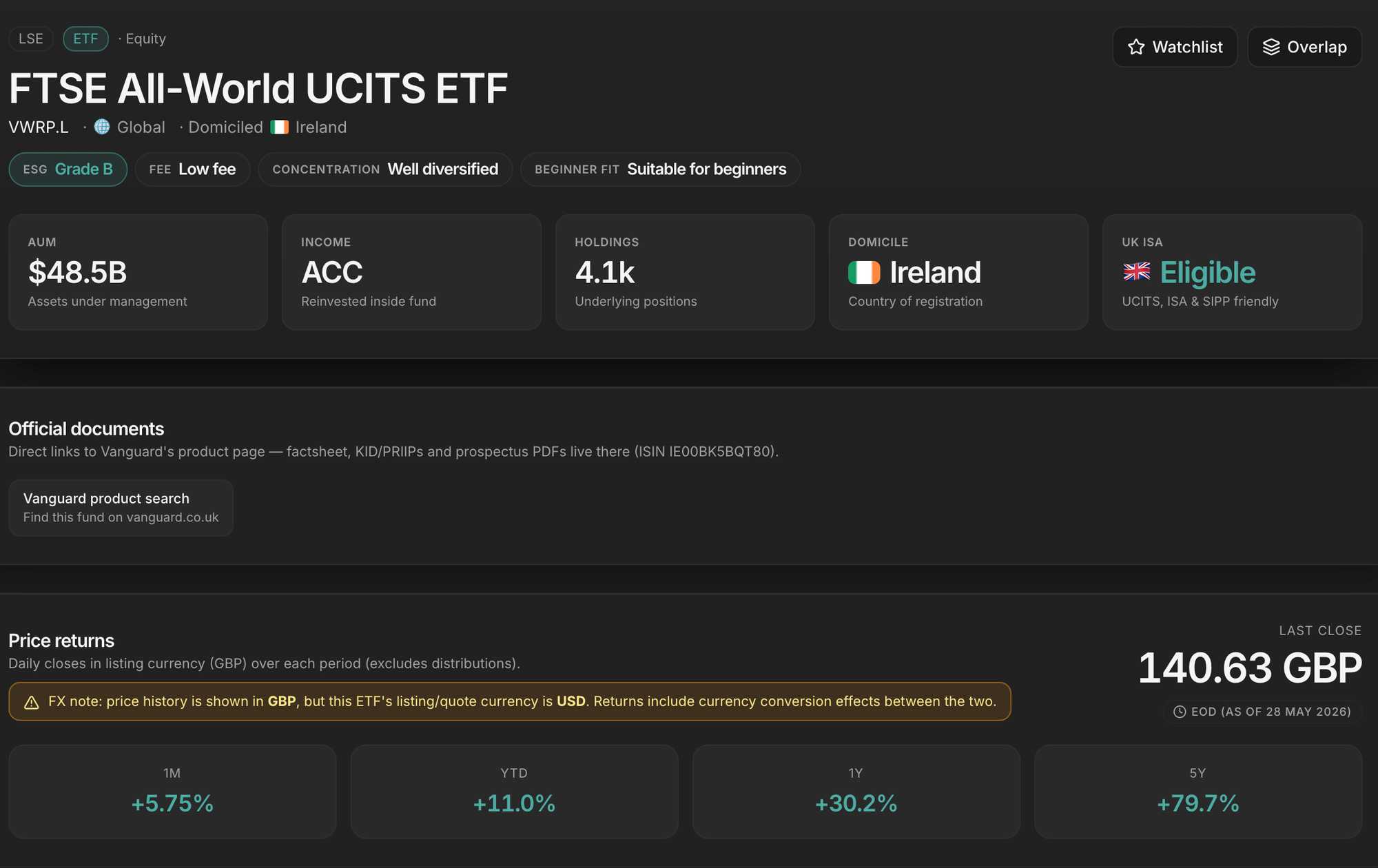
VWRP is probably the most obvious global ETF for many UK investors.
It tracks the FTSE All-World index, which means it gives you exposure to large and mid-sized companies across developed and emerging markets.
The big appeal here is trust and simplicity.
Vanguard is a well-known provider. The fund is popular. It has a strong reputation. It is easy to understand and it does the heavy lifting for you.
You are getting thousands of companies in one fund, including many of the biggest names in the world.
That will usually include companies like Apple, Microsoft, Nvidia, Amazon, Meta and other large US businesses near the top of the holdings.
This is worth understanding.
Even though it is called a global ETF, it will still be heavily weighted towards the US because the US stock market is such a large part of the global market.
That is not necessarily a bad thing. It is just how market-cap weighted funds work.
VWRP is a strong option if you want something simple, established and easy to hold for the long term.
It is not designed to be exciting.
It is designed to give you broad global exposure in one simple package.
For a lot of people, that is exactly what they need.
2. Invesco FTSE All-World UCITS ETF, FWRG
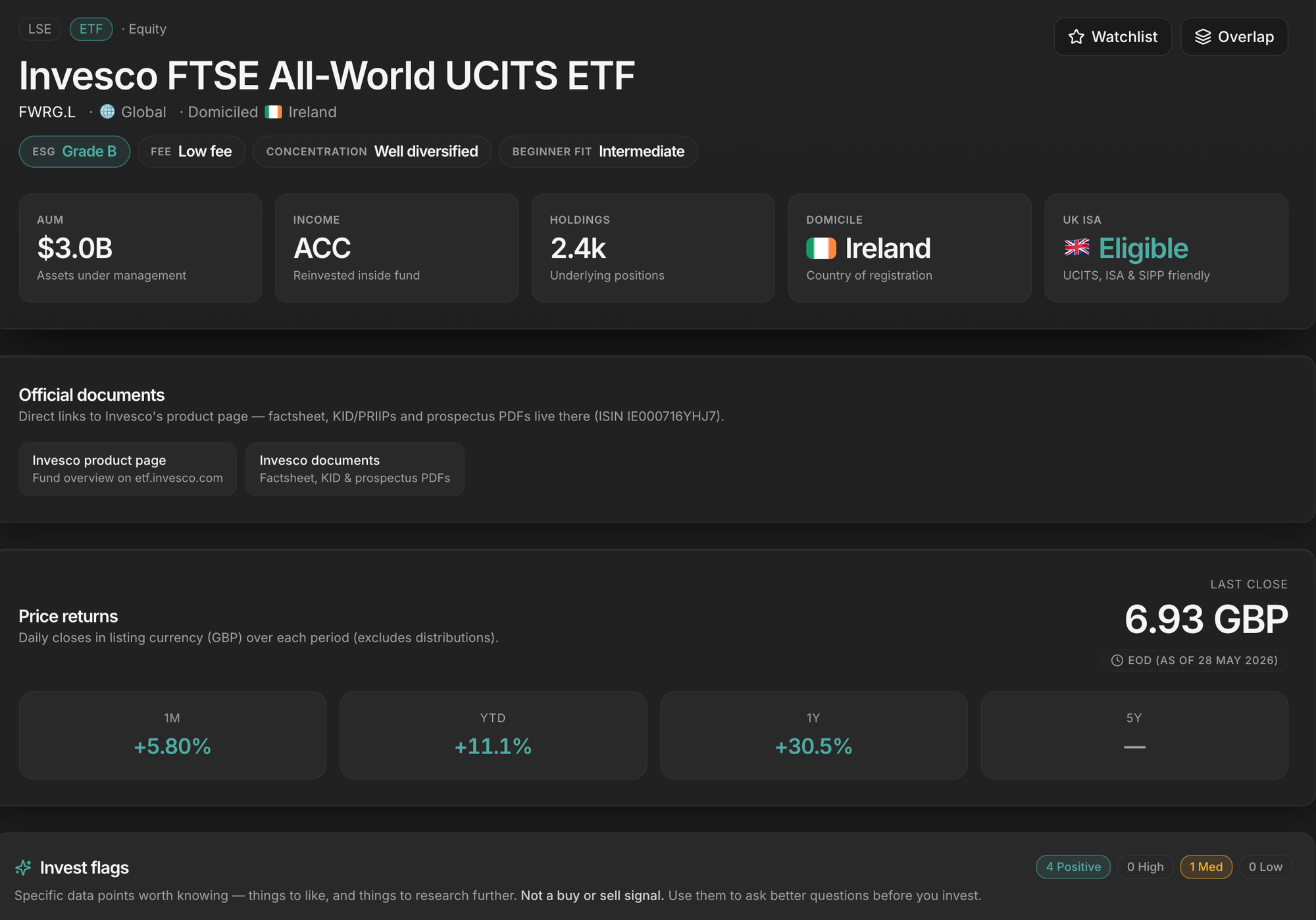
FWRG has become very popular with UK investors because it is a cheaper way to access a similar global index.
Like VWRP, it tracks the FTSE All-World index. So the basic idea is very similar.
You are getting broad exposure across developed and emerging markets, all inside one ETF.
The big selling point is the fee.
FWRG has a lower ongoing charge than VWRP, which makes it attractive for investors who want to keep costs as low as possible.
Over one year, the difference might not seem massive. But over 20, 30 or 40 years, fees do matter.
Even small percentages can compound over time.
The main downside is that FWRG is newer.
That does not automatically make it bad. Every fund had to start somewhere. But some investors prefer the comfort of a longer track record and a fund that has been tested through more market cycles.
So for me, FWRG is a strong option, but the question is whether you prefer the lower fee or the longer history of something like VWRP.
3. SPDR MSCI All Country World Investable Market UCITS ETF, IMID
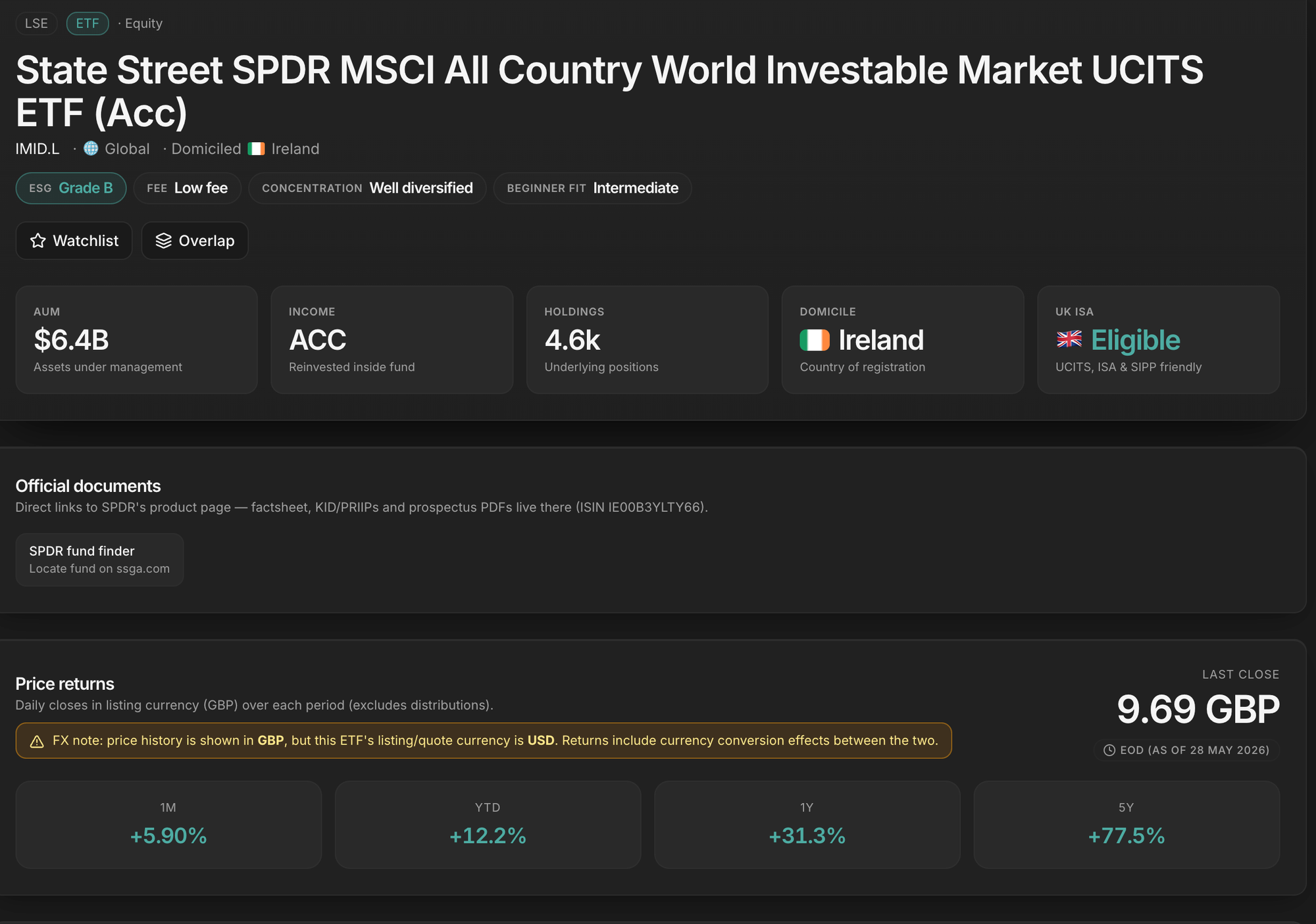
IMID is slightly different because it tracks the MSCI ACWI IMI index.
That means it aims to capture developed markets, emerging markets, large caps, mid caps and small caps.
In simple terms, it is broader.
You are not just getting the big global companies. You are also getting more exposure further down the market-cap scale.
That is the main reason some investors like it.
It gives you a very wide global spread in one ETF.
IMID may appeal to someone who wants the broadest global exposure possible from one fund.
The downside is that broader does not always mean better returns.
More holdings can be useful, but it does not automatically mean you will make more money. It can also behave slightly differently to a standard FTSE All-World fund because of the extra exposure.
That is not a problem. It is just something to understand before you buy it.

Get up to £100 in a free stock or ETF | Use code 'MATE'
Affiliate link. Capital at risk. ISA rules apply.
VWRP vs FWRG vs IMID
So which one is the best global ETF for UK investors?
The annoying answer is that it depends.
But here is the simple version.
If you want the most obvious, trusted and established option, VWRP is probably the easy choice.
If you want a similar global ETF but with a lower fee, FWRG is very attractive.
If you want the broadest exposure and like the idea of including more of the global market, IMID is worth looking at.
For most people, the difference between these funds will not be life-changing.
The bigger decision is not usually whether you pick VWRP, FWRG or IMID.
The bigger decision is whether you stay invested, keep adding, avoid messing around too much and do not overcomplicate your portfolio.
That is where most of the long-term results come from.
You probably do not need all three
This is the key point.
You probably do not need VWRP, FWRG and IMID together.
They are all trying to do a similar job.
Yes, there are differences. The index is different. The number of holdings is different. The fee is different. The provider is different.
But they are all global equity ETFs.
If you hold all three, you will get a lot of overlap, especially in the top 10 holdings.
That means your portfolio might look more complicated without actually being much more diversified.
This is where a lot of investors go wrong.
They think more funds means more diversification.
Sometimes it does.
But sometimes it just means more duplication.
What about the S&P 500 or Nasdaq?
Some investors might look at global ETFs and think they are a bit boring.
And to be fair, they are.
That is kind of the point.
A global ETF is designed to be broad and simple. It is not designed to be the most aggressive option.
If you want more potential growth, you might look at something like the S&P 500 or the Nasdaq 100. But then you are taking on more concentration risk, especially in US large-cap technology.
That can work very well in some periods.
It can also hurt more when those areas fall out of favour.
So again, it comes back to what you actually want from your portfolio.
Do you want simple global exposure?
Do you want more US exposure?
Do you want more technology exposure?
Do you want income?
Do you want lower volatility?
There is no perfect answer. There is only the answer that fits your plan.
Final thoughts
The best global ETF for UK investors is not always the one with the lowest fee, the biggest brand or the most holdings.
It is the one you understand, can stick with and can fit into your long-term plan.
VWRP, FWRG and IMID are all solid options in their own way.
VWRP is simple, trusted and established.
FWRG is cheaper and growing in popularity.
IMID gives you broader market exposure.
But you do not need to own all of them.
Pick your core, understand what it holds, check your overlap and keep things simple.
That is usually where the best investing decisions come from.
And if you want to compare ETFs, check overlap, look at holdings and research funds in a simpler way, that is exactly why I have been building the Your Money Mate ETF and Stock Screener.
The goal is simple.
Make investing easier to understand, without all the noise.


