


Get up to £100 in a free stock or ETF | Use code 'MATE'
Affiliate link. Capital at risk. ISA rules apply.
Most ETF investors do not struggle because they picked the wrong fund.
They struggle because they built a portfolio they do not understand, made it too complicated or chose something they could not stick with when the market started falling.
There are thousands of ETFs available in 2026. Open almost any investing platform and you will see global ETFs, S&P 500 ETFs, technology ETFs, dividend ETFs, small company ETFs and countless other options.
More choice does not always make investing easier.
In this guide, I want to share three simple ETF portfolios that could suit three very different types of investor:
- A simple one ETF portfolio
- A global portfolio with additional growth
- A lower volatility portfolio using shares and bonds
These are not personal recommendations. They are simple ETF portfolio examples to help you think about risk, diversification and what you are actually trying to achieve.
Start With the Type of Investor You Are
Before choosing an ETF, ask yourself a simple question.
What type of investor am I?
Some people are happy seeing their portfolio fall by 20% because they know they are investing for another 20 or 30 years.
Other people would struggle to sleep at night.
Neither person is necessarily wrong. The problem comes when you build a portfolio based on somebody else’s tolerance for risk.
Your portfolio should reflect:
- How long you plan to invest
- How comfortable you are with market falls
- Whether you want growth or income
- When you may need the money
- How involved you want to be
The portfolio with the highest potential return is not always the portfolio that will make you the wealthiest.
If a portfolio is so volatile that you panic and sell it, the potential return becomes irrelevant.
Portfolio 1: The Simple One ETF Portfolio
The first option is the simplest.
| Investment | Allocation |
|---|---|
| Global equity ETF | 100% |
A global ETF can give you exposure to thousands of companies across multiple countries and sectors in one investment.
Depending on the index it tracks, this could include companies from:
- The United States
- The United Kingdom
- Europe
- Japan
- Canada
- Australia
- Emerging markets
Instead of trying to guess which country or sector will perform best, you simply invest across the global market.
You are not trying to beat the market. You are allowing the market to do the work for you.
Why a one ETF portfolio can work
A single global ETF is:
- Easy to understand
- Easy to manage
- Globally diversified
- Suitable for regular monthly investing
- Less tempting to constantly change
For many beginners, this could be enough.
The main decision would be choosing which global ETF suits your strategy. You will need to compare its index, fees, fund size, holdings and whether it is an accumulation or distribution fund.
I have compared some popular options in my guide to the best global ETFs for UK investors.
You can also use the Your Money Mate ETF Screener to compare ETFs, fees, fund sizes, sectors and holdings.
What should you watch out for?
Most global ETFs have a large allocation to the United States.
This puts some investors off, but the US currently represents a huge part of the global stock market. It is also home to many of the world’s largest companies.
Technology companies can also make up a sizeable part of a global ETF.
That does not automatically make the fund badly diversified. It simply reflects the current size of those businesses within the market.
However, a global ETF is still a share market investment. It can fall heavily during a market crash and there is no guarantee that it will produce positive returns every year.
This portfolio is simple, but it is not risk free.
Your Money Mate Plus
ETF & Stock Screener With Premium FMP data stock selection with advanced overlap and portfolio health scores, Online Courses & Exclusive Content. With a supporting Discord Community.
Portfolio 2: A Global ETF With Growth Tilts
The second portfolio is for somebody who wants a global foundation but also wants additional exposure to specific areas.
| Investment | Example allocation |
|---|---|
| Global equity ETF | 70% |
| Global small company ETF | 15% |
| Emerging markets ETF | 15% |
The global ETF remains the core of the portfolio.
The smaller positions are the satellites. They give you more exposure to areas that may not have a large weighting inside the main global fund.
Why use a core and satellite portfolio?
The core gives you broad global diversification.
The satellites allow you to add exposure to areas you believe could perform well over the long term.
Possible satellites could include:
- Smaller companies
- Emerging markets
- Technology
- Semiconductors
- Europe
- UK companies
- Dividend paying companies
You do not need all of them.
One or two carefully selected satellite ETFs can be enough. Once you start adding five, six or ten different funds, it becomes much harder to understand what you actually own.
Be careful with ETF overlap
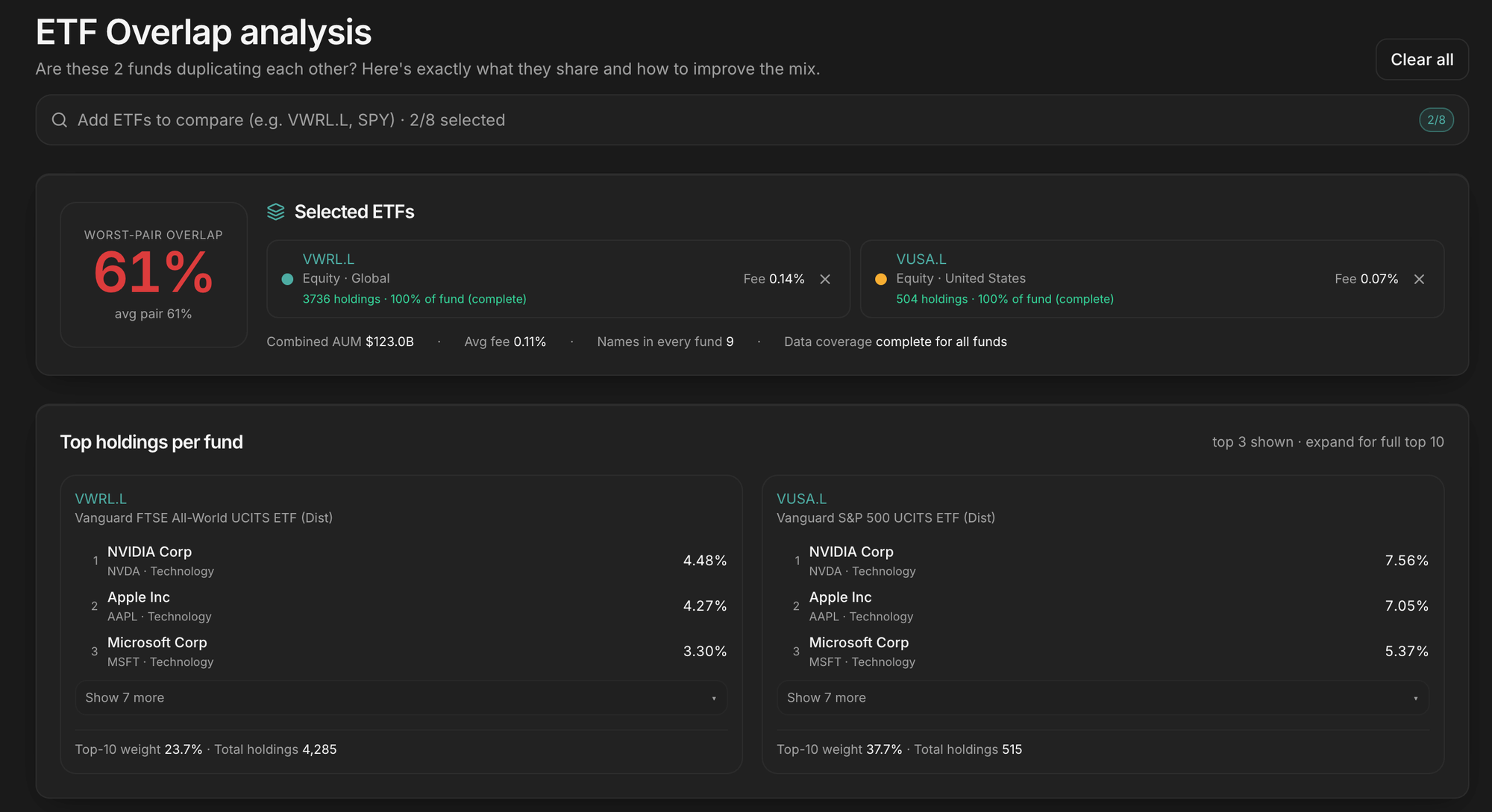
A common portfolio I see includes a global ETF, an S&P 500 ETF and a Nasdaq ETF.
It looks diversified because it contains three funds.
In reality, all three can hold many of the same large US technology companies. This means the portfolio could be much more concentrated than the investor realises.
Owning more ETFs does not automatically give you more diversification.
Diversification comes from owning different companies, sectors and markets.
You can read my full guide on how many ETFs you should own if you want to understand this in more detail.
The ETF Screener also includes an overlap tool so you can see how many holdings are repeated across different funds.
There is nothing wrong with intentionally adding more US technology exposure if that is your strategy. The important thing is understanding that you are increasing your concentration rather than creating more diversification.
Will a growth portfolio make you richer faster?
Not necessarily.
Small companies and emerging markets can underperform for years. Technology funds can also fall very quickly when valuations become stretched or investor sentiment changes.
A growth tilt should be a long term decision, not something you add because it performed well last year.
This portfolio has more moving parts and may experience more volatility than the one ETF option. It could offer greater growth, but it could also test your patience.
Portfolio 3: A Global ETF and Bond Portfolio
The final portfolio combines shares with bonds.
| Investment | Example allocation |
|---|---|
| Global equity ETF | 60% |
| Bond ETF | 40% |
This type of portfolio may suit somebody who wants to invest but is less comfortable with large stock market falls.
It could also become more relevant for investors who are approaching the point where they will need to withdraw money from their portfolio.
The global ETF provides long term growth potential. The bond allocation aims to reduce some of the volatility and provide income.

Want to see your dividends properly?
Snowball Analytics lets you track income, growth, and yield across all your investments in one place.
Why add bonds?
Bonds can potentially provide:
- Regular income
- Lower volatility than shares
- Different performance characteristics
- Greater portfolio stability
- Less reliance on the stock market
However, bonds are not guaranteed to rise when shares fall.
Bond ETFs can lose value when interest rates rise, inflation increases or the market reassesses the ability of borrowers to repay their debt.
Currency can also have a large impact on overseas bond returns, which is why some UK investors consider bond funds that are hedged back to pounds.
Bonds are not the same as cash
Money needed for an emergency fund, house deposit or major short term expense should not automatically be placed into a bond ETF.
It is still an investment and its value can fall.
This portfolio is designed to reduce volatility, not remove risk completely.
You could also adjust the allocation depending on your goals. An investor who wants more growth might choose 80% shares and 20% bonds. Somebody who prioritises stability may prefer a larger bond allocation.
Risk tolerance is personal. It is not determined by age alone.
Which Simple ETF Portfolio Is Best?
There is no single perfect ETF portfolio for every UK investor.
| Portfolio | Potentially suitable for | Main consideration |
|---|---|---|
| 100% global ETF | Beginners and long term investors wanting simplicity | Can still experience large market falls |
| Global ETF with growth tilts | Investors wanting more exposure to specific markets | Greater complexity and potential overlap |
| Global ETF and bonds | Investors wanting lower volatility or approaching withdrawals | Likely to have lower long term growth potential |
Personally, if I were starting again, I would still want a global fund at the core of my portfolio.
It gives you a foundation that can do most of the heavy lifting.
You can then decide whether you actually need anything else.
Accumulation or Distribution ETFs?
Another decision is whether to use an accumulation or distribution ETF.
An accumulation ETF automatically reinvests the income produced by its underlying investments.
A distribution ETF pays that income into your investment account as cash.
For somebody focused entirely on long term growth, an accumulation fund can make life easier because the reinvestment happens automatically.
If you use distribution ETFs while building wealth, reinvesting the income can be extremely important. Spending the dividends too early removes part of the compounding effect.
I personally like seeing income arrive, but that does not make distribution funds automatically better. It comes down to how you want your portfolio to operate.
You can read my guide to income and accumulation ETFs for a full comparison.
What Could Monthly ETF Investing Become?
The amount you invest matters, but time can matter even more.
The table below shows what regular monthly investing could potentially become over 30 years using an illustrative average annual return of 7%.
| Monthly investment | Total contributed | Illustrative value after 30 years |
|---|---|---|
| £100 | £36,000 | Around £122,000 |
| £250 | £90,000 | Around £305,000 |
| £500 | £180,000 | Around £610,000 |
These figures are illustrations, not predictions. Actual returns will change from year to year and could be higher or lower. They also do not account for inflation, platform fees or taxes.
The point is not to promise a particular number.
It is to show how consistency and time can turn smaller monthly investments into something meaningful.
You can test your own figures using my free UK investment calculator. You can change the monthly contribution, expected return, dividend yield and investment period.
The Biggest ETF Portfolio Mistakes
Whichever strategy you choose, there are several mistakes worth avoiding.
Chasing recent performance
The ETF that performed best last year will not automatically perform best next year.
Past performance can be useful, but it should not be the only reason you buy something.
Owning multiple versions of the same investment
Buying three global ETFs does not necessarily make your portfolio more global.
Different providers can offer funds that track similar indexes and hold almost identical companies.
Changing strategy constantly
A portfolio cannot compound properly if you replace it every time another investment becomes popular.
Give your strategy time to work.
Investing money you may need soon
Investing is for money you can leave alone.
Markets can fall at exactly the moment you need to withdraw, which could force you to sell at a loss.
Ignoring fees and fund structure
Check the ongoing charge, fund size, replication method, currency, index and whether the fund distributes or reinvests its income.
The cheapest ETF is not automatically the best, but fees still matter over several decades.
Frequently Asked Questions
What is the best ETF portfolio for a UK beginner?
For many beginners, one broadly diversified global ETF can provide a simple starting point. The most important thing is understanding the fund, accepting the risks and using a strategy you can maintain.
How many ETFs should I have in my portfolio?
Many investors only need one to three ETFs. The number of funds matters less than the holdings, sectors and countries inside them.
Can I own a global ETF and an S&P 500 ETF?
You can, but there is likely to be substantial overlap. A global ETF already holds many of the largest S&P 500 companies. Adding an S&P 500 ETF increases your exposure to the United States rather than automatically improving diversification.
Are ETF portfolios safe?
ETFs can provide broad diversification, but they are not risk free. Equity ETFs can fall heavily during market downturns and bond ETFs can also lose value.
Should I choose an accumulation ETF?
Accumulation ETFs can be useful for long term growth because they automatically reinvest income. Distribution ETFs provide more control and can be helpful for investors who want visible income.
How much should I invest every month?
Invest an amount you can maintain without putting your emergency fund, bills or short term goals under pressure. Consistently investing £100 per month can be more effective than attempting £500 and stopping after a few months.
Final Thoughts
The best ETF portfolio is not the one with the most funds or the most impressive recent performance.
It is the one you understand, can afford and can continue buying when markets are having a difficult year.
For some people, that will be one global ETF.
For others, it will be a global core with one or two additional growth positions.
For investors who want to reduce volatility, it may include bonds.
There is no universal perfect portfolio.
Have a plan. Understand what you own. Check the overlap. Keep investing consistently and allow time to do the work.
If you want help researching ETFs, comparing holdings and understanding what you are buying, explore the Your Money Mate ETF Screener.
You can also access my free investing course and community if you want to build your knowledge before putting a portfolio together.


