



Your Money Mate Plus
ETF & Stock Screener With Premium FMP data stock selection with advanced overlap and portfolio health scores, Online Courses & Exclusive Content. With a supporting Discord Community.
Everyone seems to be talking about Vanguard’s VALL ETF. A global fund, small companies included, and an ongoing charge of just 0.07%. You can see the appeal.
But if you already own a perfectly decent global tracker, does that mean you should sell it?
Not necessarily.
Vanguard’s VALL ETF could be a bad move for you if switching costs outweigh the fee saving, it mostly duplicates investments you already own, or you expect its extra small companies to guarantee better returns.
I like the fund. I have even bought it for my children’s accounts. But buying something for a particular account and deciding everybody should switch are two very different decisions.
Sometimes the most useful investing advice is also the least exciting: stop fiddling with something that already works.
What is Vanguard’s VALL ETF?
VALL is the London Stock Exchange’s sterling ticker for the accumulating Vanguard FTSE Global All-Cap UCITS ETF. It tracks an index covering large, medium and small companies across developed and emerging markets. Accumulating means dividends are reinvested within the fund. Vanguard’s VALL product information.
If you want the broader introduction, start with my guide to whether Vanguard’s VALL ETF could replace your portfolio.
Here, I want to focus on the decision facing existing investors: is changing what you already own actually worth it?
1. The fee saving might not justify switching
Lower fees matter. You keep more of your investment returns, and savings can build over time.
But a percentage on a factsheet needs translating into pounds before you start selling anything.
Here is the comparison using ongoing charges checked on 14 September 2026:
| Fund | Annual ongoing charge | Approximate cost on £10,000 | Approximate cost on £100,000 |
|---|---|---|---|
| VALL | 0.07% | £7 | £70 |
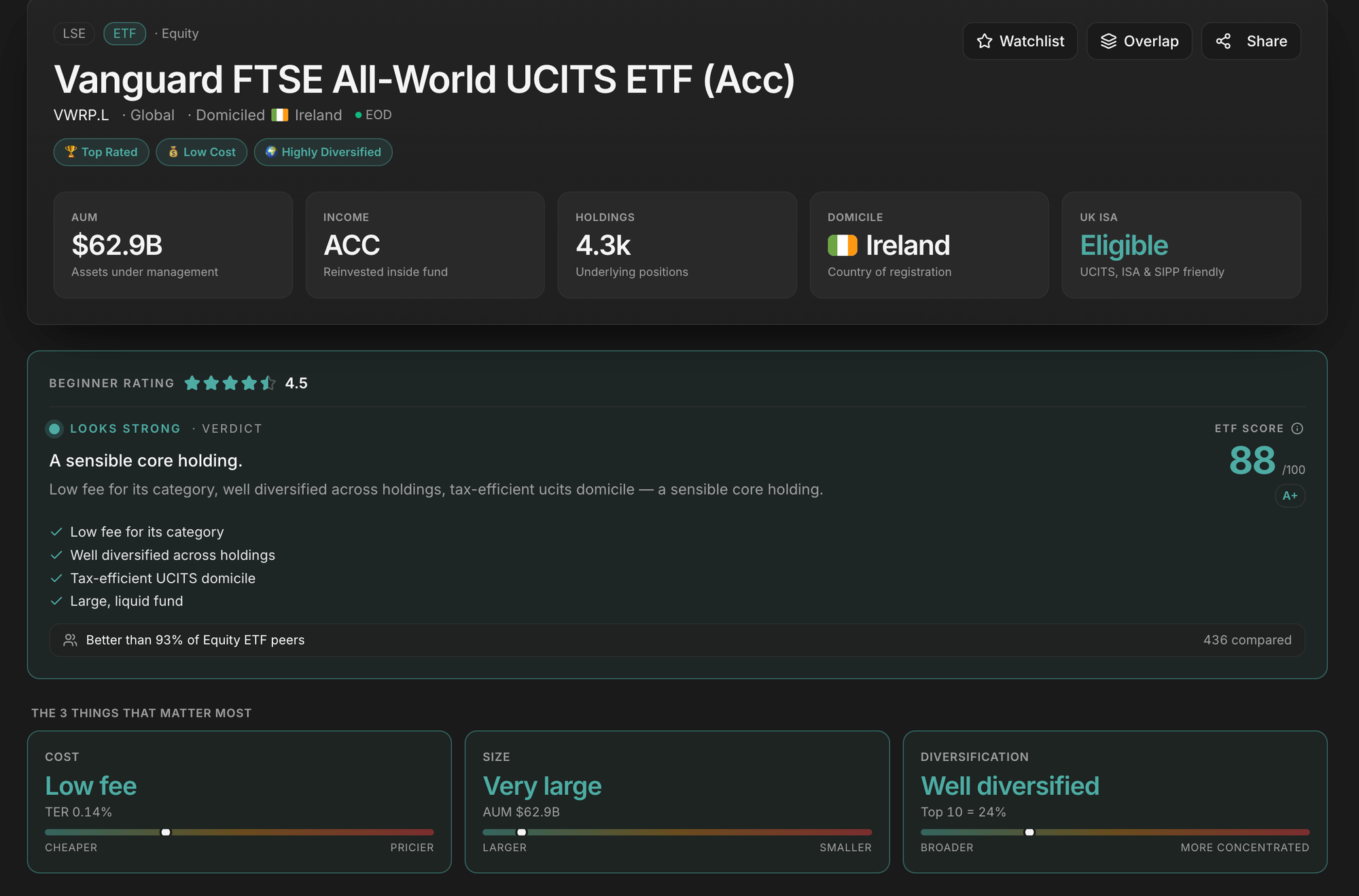
| VWRP | 0.14% | £14 | £140 |
| Mutual Fund | 0.23% | £23 | £230 |
Sources: Vanguard’s VALL, VWRP and Global All Cap Index Fund pages. Illustrations assume a constant investment value for one year and exclude platform charges, trading costs and tax. Ongoing charges are reflected in fund performance rather than billed as these fixed amounts.
Moving from VWRP to VALL saves £7 a year on £10,000, or £70 on £100,000, in ongoing charges.
That is a saving. Whether it justifies switching depends on everything else involved.
Your platform may charge for buying and selling. ETFs also have a bid-offer spread: the gap between the price you can buy at and the price you can sell at. Both affect the cost of a switch. Vanguard explains these ETF trading costs.
For example, if switching a £10,000 holding costs £20 in total, a £7 annual saving takes almost three years to recover that cost. That is a simplified calculation, assuming unchanged fees and portfolio value and ignoring differences in investment performance.
There is a stronger fee argument for somebody holding the 0.23% Global All Cap Index Fund. The difference there is £16 a year on £10,000, or £160 on £100,000.
The index fund and VALL target the same broad index, but they are different products. The existing fund is a UK OEIC, while VALL is an Irish ETF. Check how your platform charges for each and how your regular investments would work before deciding.
Check tax before chasing a cheaper fund
Selling investments in a general investment account can crystallise a capital gain. Whether tax is payable depends on your gains, available allowance, losses and circumstances. Investments sold within an ISA do not incur Capital Gains Tax. HMRC explains the rules on selling shares and fund units.
Do the whole calculation. A lower ongoing charge is useful, but it is only one part of the decision.

Get up to £100 in a free stock or ETF | Use code 'MATE'
Affiliate link. Capital at risk. ISA rules apply.
2. You may already own much of the same exposure
VWRP covers large and medium-sized companies across developed and emerging markets. VALL adds smaller companies to that global approach. Vanguard explains the difference between All-World and All-Cap.
That means substantial overlap is to be expected. You are broadening the range of company sizes, but you are not suddenly buying a completely different stock market.
If your existing global fund already does the job you bought it for, ask what problem the switch solves.
Is it lower costs? A deliberate choice to include small caps? Easier monthly investing? Those are reasons you can assess.
“Everyone is talking about it” is a much weaker starting point.
It is the same issue I explain in how many ETFs you should own: count the underlying exposure, rather than just the funds in your account.
Should you own VALL and VWRP together?
Holding both is not automatically a mistake. You might keep an existing holding to avoid a taxable sale while putting new contributions into another fund.
But buying both does not give you twice the diversification. Much of your money will still be invested in overlapping companies.
There is also a simple weighting effect. If half your portfolio is in an all-cap fund and half is in an all-world fund without small caps, your overall small-cap allocation is roughly half what it would be with the all-cap fund alone.
That may suit your plan. Just make sure it is a decision you understand.
3. More stocks do not guarantee better returns
It is tempting to assume that a fund with more companies must be better.
It has broader coverage. That does not automatically mean higher returns.
VALL’s index weights companies by market value, so larger businesses receive larger allocations. Thousands of smaller holdings do not mean small companies dominate the fund. Vanguard describes its index and investment approach.
Here is a simple illustration. Imagine a portfolio has 5% in small caps and 95% in everything else. If small caps return 20% while the rest returns 10%, the portfolio returns approximately 10.5% before costs.
The smaller companies helped. Their weight limited how much they helped.
That 5% is an illustration, not a statement of VALL’s current allocation or a return forecast. The same weighting principle applies when small caps underperform.
Smaller companies can also be more volatile. Adding them does not make a global equity ETF safe or protect it from a market fall. Vanguard’s investment-risk information.
Be careful with historical comparisons, too. VALL only began in August 2026, so any five-year comparison must use an index or another fund as a stand-in. It cannot be VALL’s own five-year record. Currency, dates, dividends and fees all need to match for a useful comparison.
If you want a larger small-cap allocation, a separate fund gives you more control over the percentage. It also adds another holding, potentially different costs and a rebalancing decision. My guide to three simple ETF portfolios for UK investors explains how a global core and additional allocations can fit together.
More control can be useful. It still does not promise better results.
Why I bought VALL for my children’s accounts
In the video, I explain that I switched the All-World holdings in my children’s accounts to VALL, while keeping the All-World fund in my pension.
One practical attraction was the lower price per ETF share. Where a platform only lets you buy whole shares, a lower share price can make small contributions easier to invest with less cash left over.
That does not mean you get a better investment simply because you own more units. A £100 investment rising 10% gains £10, regardless of how many shares that £100 bought.
For somebody starting from scratch who wants one global equity fund, including small companies, VALL is a compelling option to research. For an existing investor, the switching calculation matters more.
And for me, keeping the All-World fund in my pension remains a choice I am comfortable with. My children’s accounts and my pension do not need identical decisions.
Before you switch to VALL
Ask yourself:
- How much would I save each year in pounds?
- What would selling and buying cost, including any tax?
- Do I actually want the change in small-cap exposure?
- Does my platform support the fund and the way I want to invest?
- Am I improving my plan, or reacting to the latest ETF excitement?
You do not have to change funds just because a cheaper one appears. Equally, staying put should not mean refusing to review a worthwhile saving.
Use my free ETF screener to compare fund fees, size and exposure before making your decision. Free membership is required. Check each provider’s latest documents for anything missing from the data.
VALL and chill could work. All-World and chill could work too.
The important bit is having a reason for your choice and then actually giving yourself permission to chill.
This article is for education, not personal financial advice. Investments can fall as well as rise, and you may get back less than you invest. Past performance does not reliably predict future returns. Tax treatment depends on your circumstances and can change.


