


If you own five, six, or even ten ETFs, there’s a very good chance you’re actually owning the same companies multiple times without realising it.
This article explains:
- How many ETFs most investors actually need
- Why owning too many ETFs can create hidden concentration risk
- A simple ETF portfolio structure many UK investors use
- How to spot ETF overlap in your portfolio
Before we begin, ask yourself this question:
How many ETFs do you currently own and do you actually know how diversified you are?
The Simple Answer: Most Investors Only Need 2–3 ETFs
For most long-term investors, two or three ETFs is usually enough.
That might sound surprising in a world where influencers constantly recommend buying multiple funds.
But diversification doesn’t come from the number of ETFs you own.
It comes from what those ETFs actually hold.
Many funds track very similar indexes and therefore hold the same companies.
For example:
- Global ETFs
- S&P 500 ETFs
- NASDAQ ETFs
These often contain the same large technology companies such as:
- Apple
- Microsoft
- Nvidia
- Amazon
- Alphabet
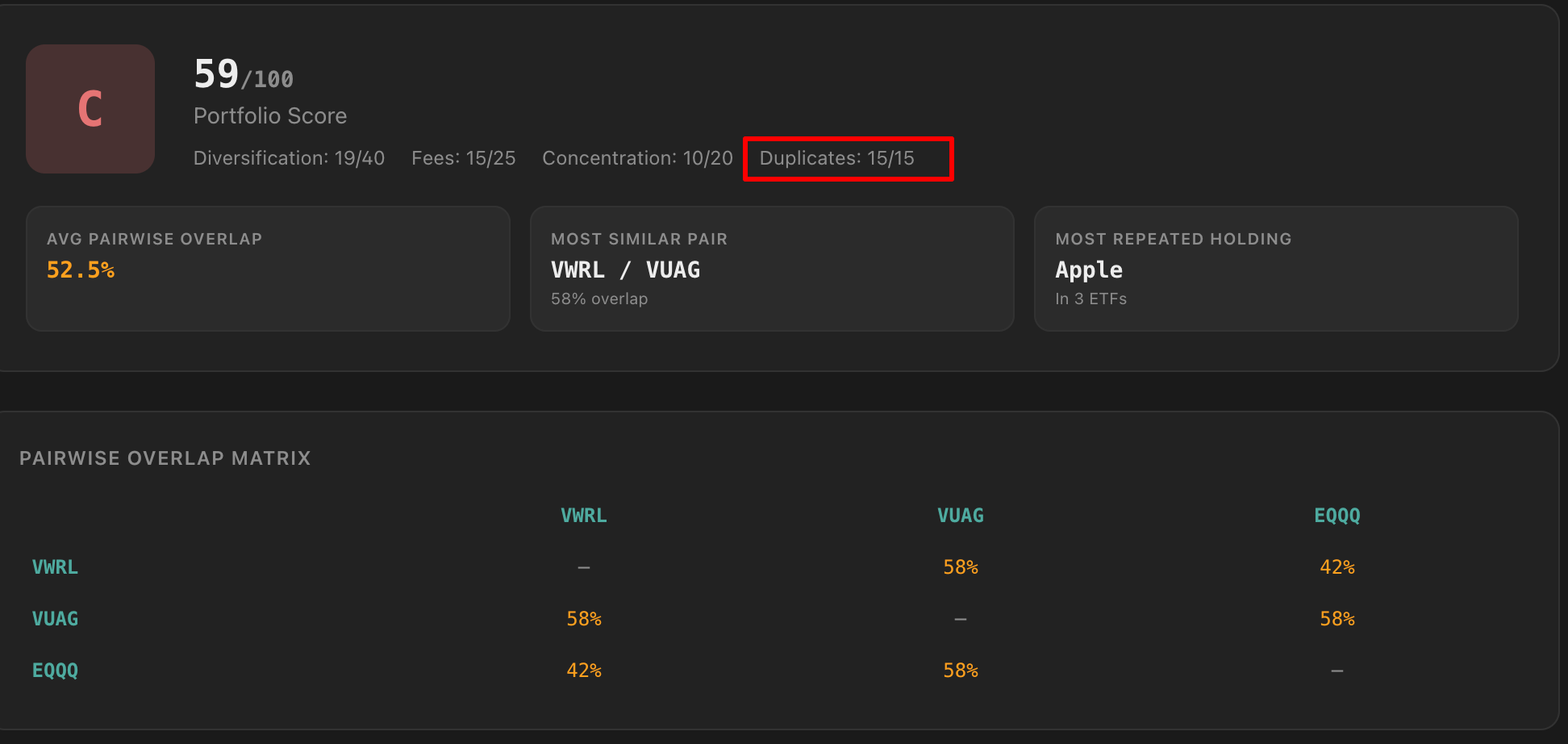
So even if you own multiple ETFs, your portfolio may still be heavily concentrated in a handful of companies.
Strategy 1: The One ETF Portfolio
The simplest strategy is owning one global ETF.
Many investors choose a global index fund that tracks developed and emerging markets.
Examples typically track indexes like:
- MSCI ACWI
- FTSE All-World
These funds already contain thousands of companies worldwide.
A typical global ETF might include:
- United States (largest weighting)
- Europe
- Japan
- United Kingdom
- Emerging markets such as China or India
For beginners, this approach can be extremely effective.
One ETF gives you:
- Global diversification
- Low costs
- Simple portfolio management
It’s not lazy.
It’s efficient.
And historically, global index funds have delivered strong long-term results compared with leaving money in cash or savings accounts.

Your Money Mate ETF Screener
Find, Analyse and Research ETFs with our screener
Strategy 2: The 2–3 ETF Portfolio (Core + Tilt)
Many investors prefer adding one or two additional ETFs alongside a global fund.
This creates a core and satellite strategy.
The idea is simple.
Your main holding covers the entire market, while smaller allocations add specific exposure.
Step 1: Your Core ETF
Typically 70–90% of your portfolio.
This is usually a global ETF covering developed and emerging markets.
This keeps your portfolio diversified and stable.
Step 2: Add a Tilt (Optional)
Your second ETF may target a specific investment theme.
Common tilts include:
Technology / Growth
Some investors add an ETF tracking:
- NASDAQ
- S&P 500
These provide heavier exposure to major US technology companies.
However, remember:
Global ETFs already contain many of these stocks.
So adding another US-focused ETF increases your exposure significantly.
Income / Dividend ETFs
Income ETFs focus on companies that pay strong dividends.
These can appeal to investors looking to generate income over time.
Dividend funds often include sectors like:
- Financials
- Energy
- Consumer staples
They may also have different holdings than growth-focused funds, which can improve diversification.
Home Bias ETFs
Some investors like adding exposure to their domestic market.
For UK investors this might include:
- FTSE 100 ETFs
- UK dividend ETFs
This can increase exposure to companies and currencies closer to home.
Why Too Many ETFs Can Be a Problem
Many portfolios look diversified on the surface.
But when you examine the holdings, you often see something like this:
- Global ETF
- S&P 500 ETF
- NASDAQ ETF
At first glance that seems balanced. But the reality is different.
Those three funds can easily lead to 90%+ exposure to the United States.
Even worse, the top 10 companies may dominate all three funds.
For example:
| Company | Appears In |
|---|---|
| Apple | All World, S&P 500, NASDAQ |
| Microsoft | All three |
| Nvidia | All three |
| Amazon | All three |
So your portfolio might appear diversified across multiple ETFs, but actually be heavily concentrated in the same stocks.
This is known as ETF overlap.

ETF Overlap Explained
ETF overlap happens when multiple funds hold the same companies.
The result is hidden concentration.
For example:
If three ETFs each allocate 8–10% to Apple, your combined exposure could be far higher than you realise.
This increases risk because:
- A small number of companies drive portfolio performance
- Market downturns in one sector impact multiple ETFs at once
- Diversification becomes an illusion
That’s why understanding ETF holdings is critical.
When Owning More Than Three ETFs Makes Sense
There are situations where holding more ETFs can be reasonable. This usually happens when investors want very specific exposures.
Examples include:
- Small-cap ETFs
- Emerging markets ETFs
- Sector ETFs (AI, energy, healthcare)
- Commodity ETFs
- Thematic investing
But these allocations are usually small percentages of a portfolio.
For example:
- 80% core global ETF
- 10% dividend ETF
- 5% small-cap ETF
- 5% thematic exposure
The key difference is intentional allocation, not random diversification.

Want to see your dividends properly?
Snowball Analytics lets you track income, growth, and yield across all your investments in one place.
Example of a Simple ETF Portfolio Structure
A simple portfolio could look like:
| Allocation | ETF Type |
|---|---|
| 70–90% | Global All-World ETF |
| 10–20% | Dividend / Income ETF |
| Optional | Home market ETF |
This keeps the portfolio:
- Easy to manage
- Diversified globally
- Focused on long-term growth
Most importantly, it avoids unnecessary overlap.
Diversification Isn't About Quantity
Many investors fall into the trap of thinking more ETFs equals more diversification.
But diversification comes from exposure to different companies, sectors and regions not simply owning more funds.
Sometimes the simplest portfolios perform the best.
Because they are easier to understand and easier to stick with.
The Most Important Investing Principle
At the end of the day, building wealth through investing is rarely about complexity.
It’s about time in the market.
You don’t need ten ETFs.
You need:
- A solid investment strategy
- Consistent contributions
- Long-term patience
Twenty years in a well-constructed portfolio often matters far more than constantly tweaking your investments.
Tools to Analyse Your ETF Portfolio
If you want to understand your portfolio better, tools can help you analyse:
- ETF overlap
- Country exposure
- Sector allocation
- Top holdings
You can also simulate portfolios to see how diversified they really are.
👉 You can explore tools like the ETF Screener
They allow you to:
- Research ETFs
- Analyse holdings
- Understand diversification risks


